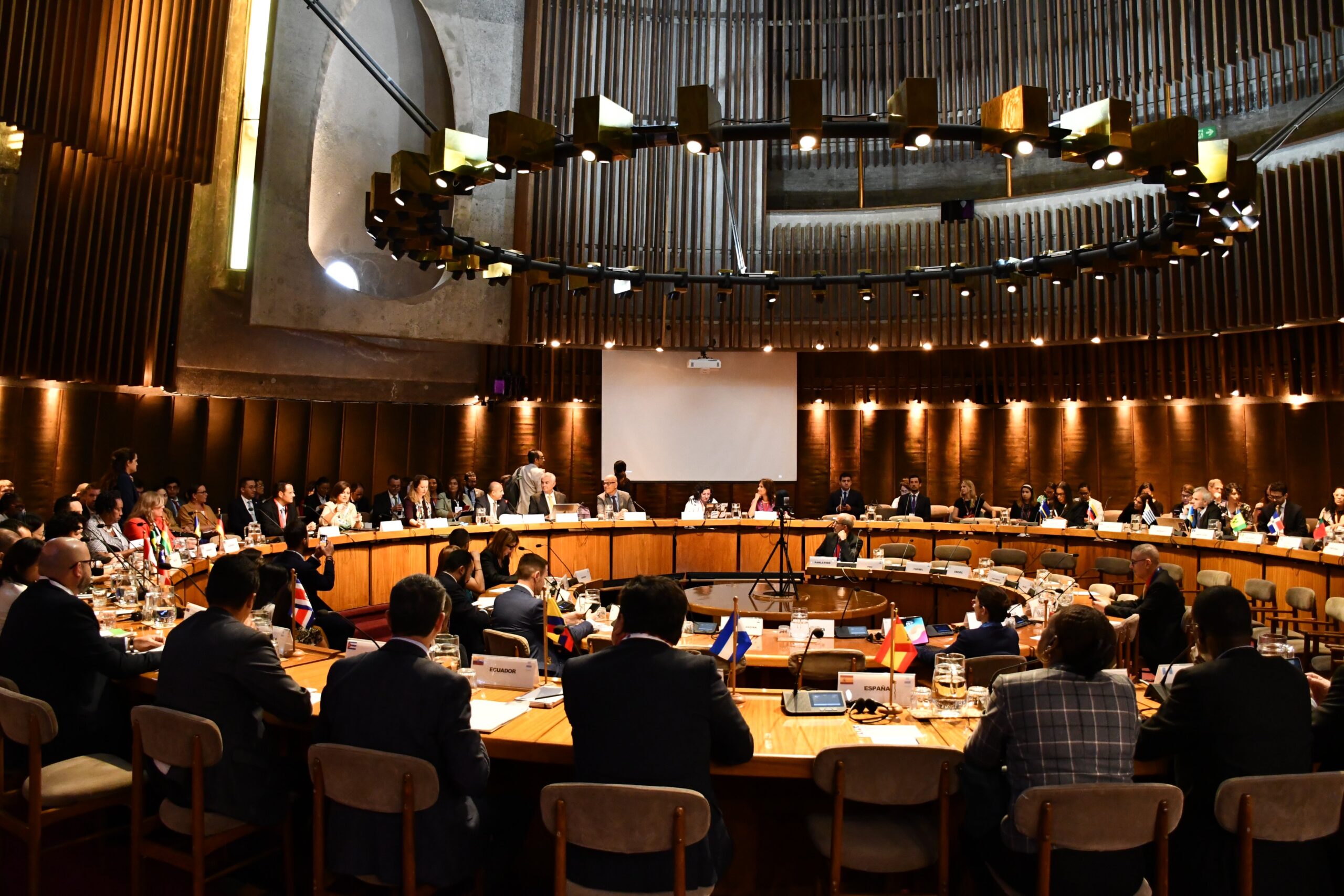
Organised by United Nations Network on Migration and hosted by the International organisation for Migration: promoting safe, regular, and dignified migration. The Second Regional Review Meeting on the implementation of the Global Compact for Safe, Orderly, and Regular Migration (GCM) in Latin America and the Caribbean was successfully held from March 18-20, 2025, at the United Nations Economic Commission for Latin America and the Caribbean (ECLAC) Headquarters in Santiago, Chile.
The three-day event was co-chaired by the International Organization for Migration (IOM), as the Coordinator of the United Nations Network on Migration (UNNM), and the United Nations Economic Commission for Latin America and the Caribbean (ECLAC). The meeting brought together ECLAC Member States and associate members, intergovernmental organizations, United Nations programmes, funds and agencies, as well as relevant stakeholders including civil society organizations, migrant associations, faith-based organizations, local authorities, private sector representatives, trade unions, parliamentarians, human rights institutions, and academia.
Multi-stakeholder Hearing
The event began with a Multi-stakeholder Hearing on March 18, which provided a platform for diverse voices to share perspectives on migration governance in the region. This hearing proved invaluable in preparing key messages for the intergovernmental meeting that followed.
Thematic Sessions
The intergovernmental meeting featured a high-level panel on regular pathways, followed by four comprehensive thematic sessions aligned with the roundtables of the International Migration Review Forum (IMRF). 
Session 4 on “Data, evidence-based policies and international cooperation” was expertly moderated by Ms. Simone Sills, Executive Director of the National Coordinating Coalition Inc. Under her guidance, participants engaged in meaningful discussions about GCM Objectives 1, 3, 7, 17, and 23, focusing on strengthening data collection, analysis, and international cooperation on migration issues. Ms. Sills facilitated an insightful exchange of ideas and best practices, highlighting the importance of evidence-based policymaking in addressing migration challenges.
Other sessions covered crucial topics including:
- Session 1: Inclusion (Objectives 14, 15, 16, 19, 20, and 22)
- Session 2: Drivers of Migration and regular routes (Objectives 2, 5, 6, 12, and 18)
- Session 3: Migration governance, saving lives, and sustainable reintegration (Objectives 4, 8, 9, 10, 11, 13, and 21)
Regional Progress and Future Commitments
The meeting allowed Member States and other stakeholders to assess progress in implementing the GCM since the first regional review in 2021, identify ongoing challenges, and explore opportunities to strengthen regional cooperation. Participating countries shared updates on their national implementation plans and integration of GCM principles into existing frameworks and policies.

Several member states announced new pledges under the UNNM Pledging Initiative, demonstrating their commitment to advancing the objectives of the GCM through concrete actions and regional collaboration.
Outcome and Next Steps
The Regional Review Meeting resulted in a comprehensive summary report synthesizing inputs from both the Intergovernmental Meeting and the Multi-stakeholder Hearing. This report, soon to be published on the UNNM website, will serve as a key input to the 2026 International Migration Review Forum.
The meeting concluded with consensus on key findings and recommendations, providing a roadmap for continued implementation of the GCM in Latin America and the Caribbean over the coming years.
The organizers extended their appreciation to all participants for their valuable contributions and to the host country, Chile, for its hospitality and support in making the Second Regional Review Meeting a success.
This regional review was made possible through the collaboration of IOM, ECLAC, and all members of the Regional UNNM for Latin America and the Caribbean, with the participation of relevant stakeholders from across the region.